The purpose of Poetslife is to promote the art and discipline of American Tactical Civil Defense for families and small businesses and to contribute practical American civil defense preparedness guidance for all Americans through my articles in the The American Civil Defense Association (TACDA.ORG) Journal of Civil Defense and leadership as the volunteer Vice President of TACDA.

3/18/2009

Mom Gets Twitter


Twitter is the fastest way to share and get information on the web.
  • Add followers, but do it slowly, trying to keep your followers and followees pretty equal.
  • Tweet — at least once a day, so you don’t look like a bot.
  • It takes time at first to build up followers and a good list of followees, but once you’re established, you can do anything on Twitter.
  • If you want to have any sort of online presence, you should start with Twitter (which can automatically update your Facebook account and your blog, so it’s really not adding too much extra effort).
  • Microblogging. It’s like a series of Facebook status updates in 140 characters, but better: more interactive, more open. Combines elements of StumbleUpon, Facebook, Email, IM, social/business mixers, and blogging.
  • Network. Connect with people...Share stories/pictures/ideas. Send news articles (shorten links using tinyurl.com or tr.im), upload photos (twitpic.com), or take a poll to see if an idea is interesting
  • Promote your product/website/brandTweet giveaways, events, sales, links to special posts. When people offer to stumble, don’t be shy.
  • Provide customer Service. Set up an RSS feed for your brand name on search.twitter.com. (e.g. Chris Brogan)
  • Build Relationships. Have real people (more than one, if possible) at your company tweet. Be personable and likeable (use humor). Interact, link to other companies.
  • Find mentors/sponsors. Follow people who are doing what you want to be doing, or who give opportunities to the people who are doing what you want to be doing.
  • Sign up on Twitter, then explore the different platforms to access Twitter (on the web, on your iGoogle homepage, on your phone, on your desktop). 
  • Find an app that works for you. Many people like Tweetdeck and Twirl. Iphone users like Twitterfon.
  • How To Twitter (Wall Street Journal)  (Note on settings — WSJ is mistaken. You can (now) determine whether you get all @replies or none, or only those that are between people, both of whom you follow).
  • 50 Ideas on Using Twitter for Business (Chris Brogan)

2/22/2009

Tools for Landing a Better Job

Lifehacker has a timely post called, "Top 10 Tools for Landing a Better Job." They describe it as, "From the first Google search to the last interview, you can boost your odds at landing a better job with the right preparation. Here are our ten best tools and tips for job-seekers and career climbers." it has good advice and great links. Good luck.

Here they provide a link to an earlier post about the 5 best online search engines.

Cybersecurity: Keeping the Pipe Open

I3P the Institute for Information Infrastructure Protection, just released a study about how to keep the pipe secure called National Cyber Security. We can only hope the policy makers and politicians will read it and act before the deluge.

2/07/2009

Business Growth through Social Media

How to Use Web 2.0 and Social Media Tools to Build Customer Trust and Convert it to Sales
I recently talked to small business owners in Mt. Airy, MD about how to use social media tools to attract customers. I repeat the main points here for other business owners who may want to know about how to use these very, very powerful tools to attract customers and create a long-lasting relationship with them based on mutual trust.
Main tip: Use Twitter to make your business grow.
What are social media tools
  • They’re fun.
  • They create a social story…not a technology story.
  • Web 2.0 tools and social media tools, when used in concert (social media starfish), can develop relationships with customers, increase trust between a business and customers, and convert those relationships to sales.
  • Web 2.0 tools are created and posted online to create, collaborate and share information with others.
  • Every business has a community around it…use it!
  • The Positive: These social media tools are very powerful (Twitter, for example). We can revolutionize the way that we communicate with customers using these tools to form better, stronger, and richer relationships.
  • The Negative: Someone does not like your business or product they can broadcast it very widely…and the negative comment stays out there a very long time.
  • By using a “starfish” approach: business owners and employees create user-friendly blogs, connect (via Mogulus, FriendFeed, Qik, Seemic, and Twitter with brightkit for quick notes, Facebook, Twitter, SMS, Broadband Mechanics, etc. for longer talks), keep notes digitally (via Livescribe), create new products (greenplug, bug labs), post relevant products to social media (ping.fm, flickr, YouTube), and post creative outreach videos (on You Tube Facebook, Mogulus tv) to collaborate with customers.
  • Robert Scoble’s Social Media Starfish is a diagram that provides a representation of some of the current Web 2.0 and social media tools. The most important concept in this diagram is “conversions.” If these social media tools are used correctly, they convert buyers into willing, passionate, and loyal customers with larger, deeper, and more extensive relationships.
Most importantly, they buy from you over and over again.
The companies, social media, and other Web 2.0 tools shown here change constantly. You need to keep up with those changes…especially, “The Cloud.”
Find Scoble’s latest finds at:

Why use social media tools
  • To compete successfully, you can use these Web 2.0 and social media tools to your advantage to leverage world-class products into world-class relationships.
  • These tools can be used to build, to support, and to keep business relationships strong and long lasting.
  • There is a very large return on investment (ROI) as these tools are (mostly) free.
  • These tools eliminate the geographic barriers that have restricted relationships between a business and customers sharing a common interest.
  • These tools are very disruptive and can bring benefits or problems for a business.
  • You need to join the conversation for the best chance of making sure these social medial tools are beneficial…your competitors certainly are using them.
  • Aggregators like FriedFeed, Linkedin, Viewzi, Indeed, etc. are very powerful. Use them.
  • YOU are your best aggregator. Choose your Web 2.0 tools wisely.
The best way to see the application of these tools can be used is to see Robert Scoble’s video which can be found here: http://scobleizer.com/?s=starfish
Find a review of social media guidebook Naked Conversations on my blog http://poetslife.blogspot.com/search/label/4%20Robert%20Scoble.
I recommend you stay current with his business analysis. To do so, visit http://scobleizer.com/ and Fast Company’s website.

How to use social media tools
  • Every small business owner can create a business blog, a Facebook page, and Twitter account (with brightkit) and stay current on social media (talk to your kids)
  • Set up video networks (Facebook, Qik, Seesmic, Mogulus, Broadband Mechanics) to communicate inside and outside.
  • Mine Scoble’s ideas and follow him on FastCompany and www.scobalizer.com
  • Track, identify and use other Web 2.0 and social media tools to benefit your business (Blog Squad, for example)
  • Use viral marketing (that is, generate friends in social media that translates into more customers and sales)
  • Social technology is evolving rapidly
  • Benefit now by identifying what is useful for your future growth
Robert Scoble spoke at the World Economic Forum at Davos about social media The legs of the social media starfish as defined by Scoble include the following:
  • Blogs. Blogger. Wordpress. Blogspot.
  • Photos. Flickr. Smugmug. Zooomr. Photobucket. Facebook.
  • Videos. YouTube. Kyte. Seesmic. Facebook. DivX
  • Social networks. Facebook. BluePulse. MySpace. Hi5. Plaxo. LinkedIn. Bebo. Ping.fm. Twitter. brightkits
  • Events (face to face kind). Upcoming. Eventful. Zvents. Facebook. Meetup.
  • Email. Integration through Bacn.
  • White label social networks. Ning.
  • Wikis. Twiki. Wetpaint. PBWiki. Atlassian. SocialText.
  • Search: viewzi.
  • Audio. Podcasting networks. BlogTalkRadio. Utterz. Twittergram. 11.Microblogs. Twitter. Pownce. Jaiku. Utterz. Tumblr. FriendFeed. Twing.
  • SMS. Services that let organizations build SMS into their social media starfishes.
  • Collaborative tools. Zoho. Zimbra. Ning. Google’s documents and spreadsheets.
  • Aggregator tools: FriendFeed. Google Reader. Viewzi. Ping.fm.

1/15/2009

Emergency Management Scholarships

Emergency management scholarships are available nationwide. Here is our local notice about how to apply. Your county has these funds available as well so apply.
"The Carroll County Office of Public Safety Support Services invites Carroll County high school seniors ot apply for the Maryland Emergency Management Association's Scholarship.The Maryland Emergency Management Association offers a $1,000 scholarship in each of the state's five regions. The scholarships are designed to assist students pursuing careers in emergency management or related fields. Applicants must be seniors attending a Maryland high school.
Details? Contact Chairperson Verna Brown at 240 313 2904.

Twitter as Life Saving Tool...Again

Thanks to Janis Krums, once again Twitter beats the old school media to alert us about a tragedy. Much thanks, Janis.
Note: First responders, civil defense volunteers, emergency managers, homeland security employees, et. al., make sure you are connected to Twitter...and Twitter's many offspring, such as twitpic.
Robert Scoble was the first person in the West to know of the massive earthquake in China because someone sent him a Twitter Tweet. Once again, the value of this tool is proving itself.
Analyze, judge, sign up for, use...Twitter and its many offspring BEFORE an emergency.

FlightAware shows the flight path and a time of 0.06 for the flight. What a miracle...
About FlightAware

Founded in March of 2005, FlightAware was the first company to offer free flight tracking services for both private and commercial air traffic in the United States. FlightAware launched public operations in late 2005 and quickly became the most popular flight tracking service in the world. FlightAware's proprietary flight arrival time algorithms combined with FlightAware's powerful, intuitive, responsive, and reliable web-based interface yield the most capable and useful flight tracking application and service. FlightAware has offices in Houston, Texas and New York, New York.

Always Aware

FlightAware offers live flight data, airport information, weather maps and charts, as well as aviation news to nearly two million users a month. FlightAware also powers operational management and dispatch software, airport FIDS (flight information displays), and provides reporting data to aircraft and airport operators.

Enterprise Commercial Services

Aviation businesses (aircraft and engine manufacturers, charters operators, airlines, airport operators, government) rely on FlightAware's commercial services division for data analysis, trending, outsourcing of data processing, and finding the answer to tomorrow's aviation optimization and reliability problems.

1/10/2009

Ice Storm


1/02/2009

See Your Internet Life on Pipl

Pipl bills itself as "The most comprehensive people search on the Web."

It may be.

Enter your name and find out parts of your life that still remain long after you have moved on.


Pipl brings up your Internet life in numerous categories, such as:

  • Public Records
  • Archives
  • Personal Profiles
  • Professional and Business
  • Photos
  • Web Pages Blog Posts
  • Documentation
  • Contact Details
  • Background Reports
  • Publications

I had not thought about it since, until I searched my name on Pipl and saw some photos and, yes, there I was...and there I am. 
There you may be as well. Find out on Pipl.

12/16/2008

U.S. States Rated "C" in Emergency Preparedness

When I used to do civil defense work in the early 80's, I found the scientists, researchers, and doctors were way ahead of most people in sounding the alarm about impending emergencies. 

Sadly, the politicians in charge ignored them and their expertise. 

Nothing has changed since then.

We ignore this warning at the risk of our families and nation.  

Overall Results: C-  The results of the 2009 Report Card present a picture of an emergency care system fraught with significant challenges and under more stress than ever before. The overall grade for the nation across all five categories is a C-. This low grade is particularly reflective of the poor score in Access to Emergency Care (D-). 
Because of its direct impact on emergency services and capacity for patient care, this category of indicators accounts for 30 percent of the Report Card grade, so the poor score is especially relevant. This category also incorporates many of the issues that states have identified as their top areas of concern.24 These include:
  • Boarding of patients in emergency departments and hospital crowding
  • Lack of adequate access to on-call specialists
  • Limited access to primary care services
  • Shortages of emergency physicians and nurses
  • Ambulance diversion
  • Inadequate reimbursement from public and private insurers
  • High rates of uninsured individuals
The grades for the other categories are slightly better, but not strong enough to pull up the full national average. Both Disaster Preparedness and Quality and Patient Safety Environment receive a C+, Public Health and Injury Prevention receives a grade of C, and the Medical Liability Environment receives a grade of C-.
 Top ranked states
 (highest to lowest)
 Bottom ranked states
 (lowest to highest)
 1. Massachusetts
 2. District of Columbia
 2. Rhode Island
 4. Maryland
 5. Nebraska
 6. Minnesota
 7. Maine
 8. Kansas
 8. Pennsylvania
 10. Delaware
 10. North Dakota
 10. Utah
 51. Arkansas
 50. Oklahoma
 49. New Mexico
 48. Nevada
 47. Oregon
 46. Idaho
 45. Arizona
 44. Kentucky
 43. Michigan
 42. Wyoming


Disaster Preparedness
The overwhelming effects of Hurricane Katrina on the medical infrastructure and emergency medical response capacity of an entire region highlighted our nation’s vulnerability to major disasters. However, federal funding in this area has been lacking. For example, only 4 percent of funding from the Department of Homeland Security goes to emergency medical system preparedness.37,38,15 
As a result, although numerous states have made considerable investments in infrastructures and systems to respond to the health and emergency medical needs that may arise as a result of a natural or man made catastrophe, the overall grade in this category is a C+.
The top ranked performers in this category include the District of Columbia, Maryland, Louisiana, Pennsylvania, and North Dakota. All of these states share some commonalities in this area, including having received relatively high rates of federal funding per capita to support disaster preparedness compared to other states. 
They have written all-hazards medical response or ESF-8 plans, which are shared in most cases with EMS and essential hospital personnel. Some have high bed surge capacity and written plans to address special needs populations and supply medications for chronic conditions in the event of a disaster. 
They have relatively high rates of nurses and physicians registered in a state-based Emergency System for Advanced Registration of Volunteer Health Professionals. In addition, these states have instituted communications and notification systems, and have held drills and training for medical staff, emergency personnel, and essential hospital personnel. The lowest ranked states for Disaster Preparedness include Tennessee, Idaho, Alaska, Arkansas, and Nevada."

12/11/2008

U.S. Capitol Visitor's Center Photowalk

Rather than the chaos of trying to figure out how to visit the various U.S. Senate and U.S. House of Representatives buildings, it provides one focal point from which to enter the Capitol complex. Security, thank God, is very, very tight at the entrance especially, but throughout the edifice. 
The People's House has a new visitor's center called the U.S. Capitol Visitor Center. It is a wonder to experience and will restore your faith in the U.S. Senate and U.S. Congress.
The U.S. Capitol Police are professionals and get you through quickly but with the proper regard to prevent some jihadi or deranged individual who will be drawn to attack the beauty of these buildings and what they represent as symbols of American Democracy.
Two of the most innovative features of the U.S. Capitol Visitor Center are:
  • You first report to a visitor's desk and are issued a bar coded pass. You wear one half of the bar coded pass on your shirt as you progress through the buildings
  • A guide issues you headphones so you can hear her talk about the exhibits and history without hearing other guides guiding other groups about at the same time. 
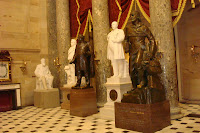
Everyone will experience their visit in a different way. Below are a few photos of my visit.